
On November 2, 2025, at the DY Patil Stadium in Navi Mumbai, 47 years of waiting ended in 52 runs.
India beat South Africa to win their first-ever ICC Women’s Cricket World Cup. Not a semi-final. Not a runners-up medal. The title. The one that had slipped through twice before in 2005 and in 2017 finally came home.
But if you think this was luck, or that this team suddenly “found its form,” you are missing the real story. The Indian women cricket team has been quietly, methodically rebuilt over the last five years. What happened in November 2025 was not a surprise to anyone watching closely. It was inevitable.
Here is everything you need to know from history, to players, to what comes next.
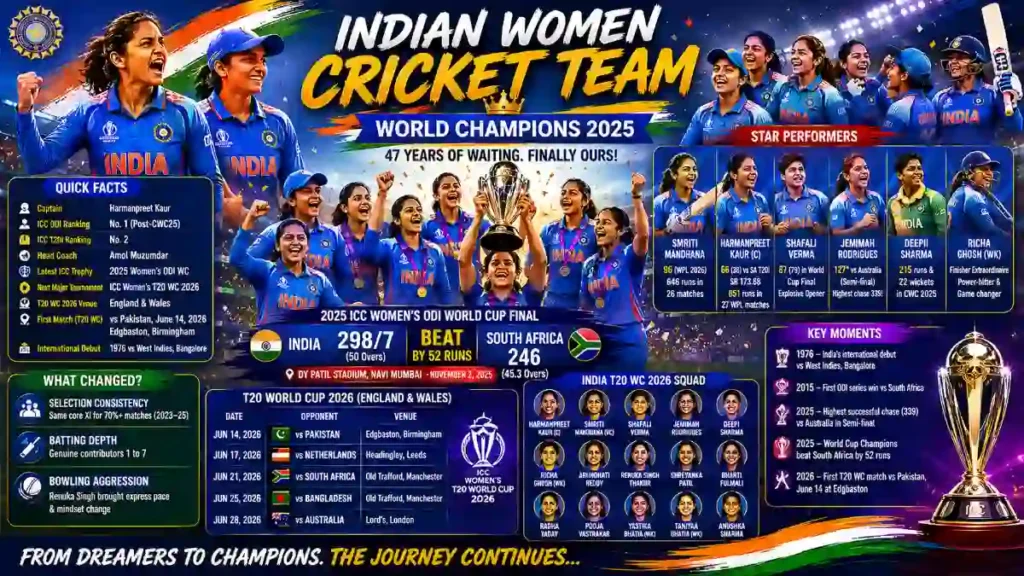
Indian Women Cricket Team: Quick Facts
| Category | Details |
| Captain | Harmanpreet Kaur |
| ICC ODI Ranking | No. 1 (post-CWC25) |
| ICC T20I Ranking | No. 2 |
| Head Coach | Amol Muzumdar |
| Latest ICC Trophy | 2025 Women’s ODI World Cup |
| Next Major Tournament | ICC Women’s T20 World Cup 2026 |
| T20 WC 2026 Venue | England and Wales |
| First Match (T20 WC) | vs Pakistan, June 14, 2026, Edgbaston |
| International Debut | 1976 vs West Indies, Bangalore |
From Heartbreak to History: The 2025 World Cup Win
The Indian women cricket team claimed their maiden World Cup title on November 2, 2025, defeating South Africa by 52 runs in the final at DY Patil Stadium, Navi Mumbai. India posted 298/7, and South Africa were bowled out for 246 despite a brilliant century from Laura Wolvaardt.
What made this win different from every previous Indian campaign was the completeness of the performance. India did not just bat well. They did not just bowl well. They executed under pressure in a final the one thing this team had historically failed to do.
The Semi-Final That Changed Everything
The final was convincing. But the semi-final was the true turning point of the tournament.
Chasing 339 against Australia the defending champions Jemimah Rodrigues scored an unbeaten 127 and Harmanpreet Kaur added 89, powering India to the highest-ever successful run-chase in women’s ODI cricket. That win, more than the final, revealed how far this team had come mentally. It is one thing to win a World Cup final. It is another to dismantle the most dominant team in women’s cricket when it matters most.
The Deepti Sharma Factor: The Most Underreported Story
What most people miss: Deepti Sharma was not a supporting act. She became the first cricketer in Women’s World Cup history to score over 200 runs AND take more than 20 wickets in a single edition finishing with 215 runs and 22 wickets, including a match-defining 5/39 in the final. No all-rounder in women’s cricket had ever done that before in a single World Cup tournament.
The Players Who Made India Champions
The rise of the Indian women cricket team is inseparable from the rise of its key individuals. Understanding the team means understanding who carries it and why each player’s role is clearly defined.
Smriti Mandhana: India’s Most Complete Batter
Smriti Mandhana is arguably the best left-handed batter in women’s cricket today. An aggressive opener who can play all formats with equal authority, she has been among the most dangerous players in international cricket since her debut in 2013. In WPL 2026, she led Royal Challengers Bengaluru to their second title and set the record for the highest individual score by an Indian in WPL history 96 off a stunning innings. Across 26 WPL matches, she has accumulated 646 runs at a strike rate above 128.
Harmanpreet Kaur: Captain, Finisher, and Big-Game Player
Harmanpreet Kaur is the captain and the emotional core of this team. In a T20I against South Africa in Johannesburg in April 2026, she scored 66 off just 38 balls at a strike rate of 173.68 her best T20I form in years. She has built a reputation not just as a match-winner but as a captain who makes bold decisions when the team needs them most. Her WPL record reinforces this: 851 runs at an average of 40.52 and a strike rate of 143.50 across 27 matches.
Shafali Verma: The Most Explosive Opener in Women’s Cricket
Shafali Verma’s 87 off 79 balls in the 2025 World Cup final was the highest score by an Indian opener in a Women’s World Cup final. She attacks from ball one, and her ability to destabilise bowling attacks inside the first six overs gives India a platform that very few teams can match. When Shafali fires, India’s total typically extends 30-40 runs beyond where it would otherwise land.
Richa Ghosh: The Finisher India Always Needed
Richa Ghosh is the wildcard who has become a match-winner. The wicketkeeper-batter hits the ball with rare power for women’s cricket and has drawn comparisons to MS Dhoni for her composure and finishing ability in death overs and she is only in her mid-twenties. Her presence at number seven means India’s innings rarely collapses at the end.
Jemimah Rodrigues: The Pressure-Cooker Performer
Jemimah Rodrigues is who India turns to when the match is on the line. Her 127 not out in the World Cup semi-final against Australia was not simply an innings it was a statement of identity. This is a team that believes it can chase anything, and Rodrigues is the reason for that belief.
What Most People Get Wrong About This Team
Here is the popular narrative: “Indian women’s cricket improved because of more money and media attention.”
That is only half the story and arguably the less important half.
What Actually Changed: Three Real Shifts
1. Selection consistency
For years, India’s selection was erratic. Players were dropped mid-series, recalled without explanation, and never given enough consecutive matches to find rhythm. That changed decisively. The core XI for the 2025 World Cup had played together for more than two years with minimal rotation. Studies of India’s squad selection show they used virtually the same core group for over 70% of matches between 2023 and 2025 a stark contrast to the constant churn before 2022.
2. Batting depth
Past India teams had two or three match-winners followed by a sharp drop-off. The 2025 squad had genuine contributors from position one through seven Rodrigues at three, Harmanpreet at four, Deepti at six, Richa at seven. No longer could opposition teams dismiss India’s tail cheaply and contain their total.
3. Bowling aggression
Renuka Singh brought genuine express pace to India’s bowling attack something women’s cricket in India had never consistently had. For a long time, India’s bowling relied on slow surfaces and defensive lines. Renuka changed that psychology. India began attacking with the new ball, taking powerplay wickets, and removing in-form batters early.
The Counterintuitive Reality
India’s biggest problem was never talent. It was belief. The 2025 World Cup win was not built in the nets. It was built in the minds of these players and that took years of near-misses, tight semi-finals, and painful exits to forge. Mental toughness is not a coaching drill. It is scar tissue.
The WPL Factor: How a Domestic League Changed Everything
The Women’s Premier League (WPL), launched in 2023, is the single most important structural development in Indian women’s cricket in the last decade.
Before the WPL, the Indian women cricket team played bilateral series, occasionally toured overseas, and trained in largely domestic conditions. The WPL changed the entire competitive environment.
The Franchise Effect
When Deepti Sharma, Shafali Verma, and Richa Ghosh share a dressing room with Nat Sciver-Brunt, Ellyse Perry, and Sophie Devine for two months every season, their understanding of high-pressure batting and bowling situations grows exponentially. They learn how world-class players approach T20 cricket from the inside not from watching, but from competing alongside them.
The Culture Shift Nobody Talks About
The WPL did not just improve individual skills. It raised India’s baseline standard of professionalism pre-match preparation, opposition data analysis, recovery protocols, power-play strategies. India women now train and prepare like a franchise team, not a touring side. That shift in culture the move from “national team on tour” to “professional franchise athlete” is more valuable than any individual stat line.
India’s 2026 Challenge: T20 World Cup and the Unfinished Business
India’s greatest single-format gap remains the T20 World Cup. They have never won it.
That changes or does not beginning June 14, 2026, when the Indian women cricket team face Pakistan at Edgbaston in Birmingham. The ICC Women’s T20 World Cup 2026 is hosted by England and Wales, beginning June 12.
India’s Group Stage Schedule T20 World Cup 2026
| Date | Opponent | Venue |
| June 14 | Pakistan | Edgbaston, Birmingham |
| June 17 | Netherlands | Headingley, Leeds |
| June 21 | South Africa | Old Trafford, Manchester |
| June 25 | Bangladesh | Old Trafford, Manchester |
| June 28 | Australia | Lord’s, London |
India’s T20 World Cup 2026 Squad
Harmanpreet Kaur (captain), Smriti Mandhana (vice-captain), Shafali Verma, Jemimah Rodrigues, Deepti Sharma, Richa Ghosh, Arundhati Reddy, Renuka Singh Thakur, Shreyanka Patil, Bharti Fulmali, Radha Yadav, Pooja Vastrakar, Yastika Bhatia, Richa Ghosh, Taniyaa Bhatia (wk).
The One Strategic Problem India Must Solve
In T20 cricket, Harmanpreet’s batting position is a genuine strategic question. She enters at four or five, which sometimes leaves her with too few balls to impose herself on a 20-over game. The team’s T20 template built around Shafali’s powerplay aggression and Smriti’s structural anchoring needs a defined role for its captain that maximises her strike rate of 173+ when she gets going.
Bold take: If India promote Harmanpreet to number three in the T20 World Cup, giving her more balls against fresh bowlers in the middle overs, they become one of the two or three most dangerous batting lineups in the tournament. This is not a radical move. It is an obvious one and the fact that it has not been used consistently is the most puzzling tactical gap in India’s current T20 setup.
The Road Ahead: Schedule, Selection, and Strategy
The build-up to the T20 World Cup has been deliberate and demanding. India played a five-match T20I series against South Africa in April 2026 their most recent international assignment and toured Australia in February 2026 for a full multi-format series including three T20Is, three ODIs, and a one-off Test.
The preparation calendar is dense and intentional. Australia away, South Africa at home, England to follow India’s management has ensured no soft preparation, no comfortable run of wins against weaker opposition.
Read More About – Pakistan National Cricket Team Vs Bangladesh National Cricket Team Matches: The Power Shift That Changed Everything
New Faces to Watch
- Anushka Sharma the emerging top-order batter who earned her first T20I call-up for the South Africa series, impressing with her clean ball-striking and composure under pressure
- Kashvee Gautam the 22-year-old fast bowler from Uttarakhand who can bowl consistently above 115 kph and could add a critical third pace dimension to India’s attack
- Bharti Fulmali selected in both earlier series and the T20 World Cup squad, she is building her reputation as a reliable middle-order finisher
Where This Team Stands in History
The Indian women cricket team began their international journey in 1976, when they played West Indies in Bangalore. Fifty years later, they are World Champions in 50-over cricket and a top-two T20 side in the world. The transformation over five decades and especially over the last five years is one of sport’s most compelling and underreported stories.
According to ICC records, the 2025 Women’s Cricket World Cup set unprecedented global viewership records, with India’s final attracting the largest audience ever for a women’s cricket match in history.
The next chapter is in England. And based on everything that has happened, you should not bet against them.
Frequently Asked Questions
Q1. When did India win the Women’s Cricket World Cup?
Ans. India won their first ICC Women’s Cricket World Cup on November 2, 2025, defeating South Africa by 52 runs in the final at DY Patil Stadium, Navi Mumbai.
Q2. Who is the captain of the Indian women cricket team?
Ans. Harmanpreet Kaur is the captain of the Indian women’s cricket team across all formats, including for the ICC Women’s T20 World Cup 2026.
Q3. Who were the top performers in the 2025 Women’s World Cup final?
Ans. Shafali Verma scored 87 off 79 balls and Deepti Sharma scored 58 with the bat and took 5/39 with the ball, winning Player of the Match. Rodrigues’ semi-final 127* was equally decisive.
Q4. What is India’s squad for the T20 World Cup 2026?
Ans. India’s T20 World Cup 2026 squad includes Harmanpreet Kaur (c), Smriti Mandhana, Shafali Verma, Jemimah Rodrigues, Deepti Sharma, Richa Ghosh, Arundhati Reddy, Renuka Singh, Shreyanka Patil, Bharti Fulmali, Radha Yadav, Pooja Vastrakar, and others.
Q5. When is India’s first match in the T20 World Cup 2026?
Ans. India play their opening match against Pakistan on June 14, 2026, at Edgbaston, Birmingham.
Q6. When did India first play women’s international cricket?
Ans. India made their first officially recognised international appearance on October 31, 1976, against West Indies in a Test match in Bangalore.
Q7. What record did Jemimah Rodrigues set in the 2025 World Cup semi-final?
Ans. Rodrigues’ unbeaten 127, combined with Harmanpreet’s 89, powered India to the highest-ever successful run-chase in women’s ODI cricket history chasing 339 against Australia.
Q8. What is Deepti Sharma’s record from the 2025 Women’s World Cup?
Ans. Deepti Sharma became the first cricketer in Women’s World Cup history to score over 200 runs and take more than 20 wickets in a single edition finishing with 215 runs and 22 wickets across the tournament.
Q9. How has the WPL helped the Indian women cricket team?
Ans. The Women’s Premier League (WPL), launched in 2023, gives Indian players regular high-intensity competition alongside the world’s best overseas players, dramatically raising tactical awareness, fitness standards, and consistency under tournament pressure.
Q10. Has India ever won the Women’s T20 World Cup?
Ans. No. India has never won the ICC Women’s T20 World Cup. Winning the 2026 edition in England would complete their clean sweep of major ICC trophies and cement their position as the most dominant force in women’s cricket.