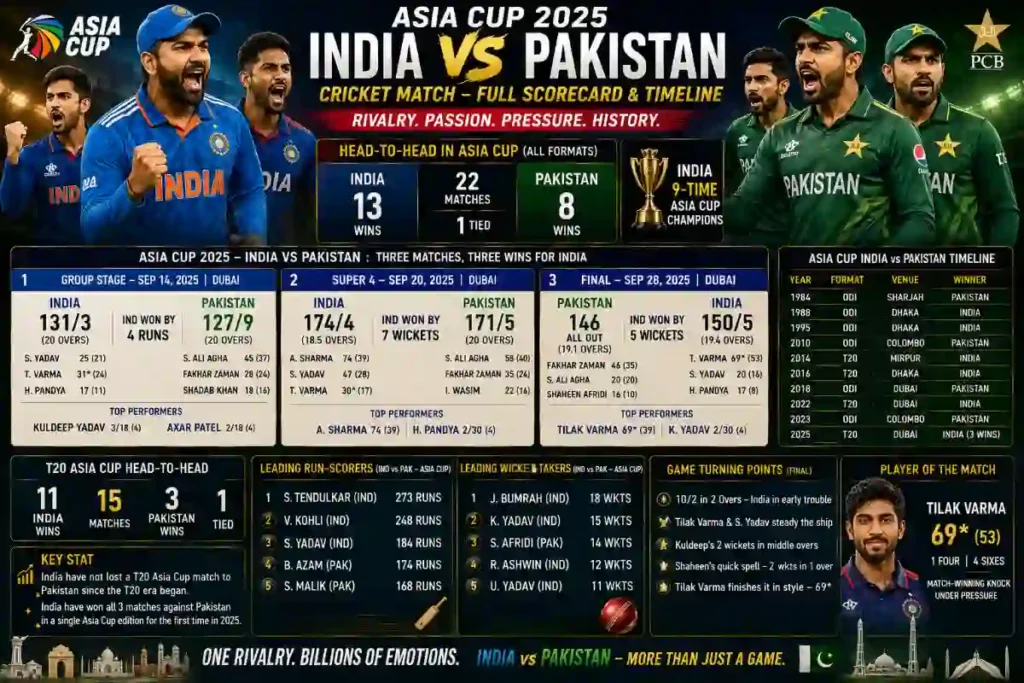

India and Pakistan have met 22 times in Asia Cup history. India lead 13–8, with one match tied.
That sentence alone separates this article from every match report you have already read. Because the real question is not what the numbers are it is what the numbers reveal about how each team is built, how they think under pressure, and why one team keeps winning when it matters most.
The Asia Cup India vs Pakistan cricket match is not just a fixture. It is a structured psychological contest that plays out the same way, again and again, because the structural imbalances between these two sides have never fully been resolved.
In T20-format Asia Cup matches specifically, India’s dominance sharpens further 11 wins against Pakistan’s 3. In a format designed for unpredictability, India have made this fixture feel almost predictable.
India vs Pakistan Asia Cup Head-to-Head at a Glance
| Format | Matches | India Wins | Pakistan Wins | Ties |
| All Asia Cup editions | 22 | 13 | 8 | 1 |
| T20 Asia Cup only | 15 | 11 | 3 | 1 |
| Asia Cup Finals (all formats) | 5 | 2 | 3 | 0 |
What this table actually tells you: Pakistan have won 3 of 5 Asia Cup finals involving India but nearly all in the ODI era. The T20 era has been India’s dominion entirely. That format split is the most underreported detail in any discussion of this rivalry.
Asia Cup India vs Pakistan Timeline: Every Key Result
One of the biggest gaps in most articles covering the Asia Cup India vs Pakistan cricket match rivalry is a clean historical timeline. Here it is.
Year-by-Year Results
| Year | Format | Winner | Key Moment |
| 1984 | ODI | Pakistan | Inaugural Asia Cup edition |
| 1988 | ODI | India | India’s first Asia Cup trophy run |
| 1995 | ODI | India | Dominant bowling display |
| 2010 | ODI | Pakistan | Clinical chase by Pakistan |
| 2014 | T20 | India | India’s spinners strangled Pakistan |
| 2016 | T20 | India | India won by 5 wickets in a pressure finish |
| 2018 | ODI | Pakistan | One of Pakistan’s last big wins in this fixture |
| 2022 | T20 | India | India won by 5 wickets wrist spin was decisive |
| 2023 | ODI | Pakistan | Pakistan’s last Asia Cup win over India |
| 2025 (Group) | T20 | India | Kuldeep 3/18, India won by 4 runs |
| 2025 (Super 4) | T20 | India | Abhishek 74 off 39, India won by 7 wickets |
| 2025 (Final) | T20 | India | Tilak Varma 69*, India won by 5 wickets |
The pattern is unmistakable. Since the T20 format became dominant in Asia Cup cricket, India have not lost a T20 Asia Cup match against Pakistan. That is not an accident. That is structural superiority.
Asia Cup 2025: India’s Most Complete Sweep
The Asia Cup 2025 in Dubai was India’s definitive statement in this rivalry not because they won, but because they won three times against the same opposition in a single tournament.
Group stage. Super Fours. Final. Three matches. Three wins. Zero doubt.
No team in Asia Cup history had done this against Pakistan before. Most analysts focused on individual performances. What they missed was the systemic nature of the dismantling.
Group Stage: Kuldeep and Axar Take Pakistan Apart
India posted 131 for 3 on September 14 not a threatening total on paper. But the bowling that followed turned a modest score into an unassailable one.
- Kuldeep Yadav: 3 for 18
- Axar Patel: 2 for 18
- Jasprit Bumrah: 2 for 28
Pakistan finished 127 for 9 four runs short with one wicket remaining.
What most people miss: Pakistan were not bowled out. They had a batter at the crease. They simply could not score five runs with a wicket in hand. That is not a talent failure. That is a pressure-execution failure and it is the defining characteristic of Pakistan’s batting in this fixture across the modern era.
The wrist spin combination of Kuldeep and Axar was not improvised. It was targeted. Pakistan’s middle order has a documented vulnerability against wrist spin they cannot read particularly Kuldeep’s googly. India identified this weakness in 2019 and have systematically exploited it in every T20 Asia Cup India vs Pakistan cricket match since.
Super Fours: Abhishek Sharma Destroys the Game Plan
The Super Fours meeting on September 20 was decided before Pakistan had even warmed up properly.
Abhishek Sharma walked out and hit 74 off 39 balls in the powerplay. India reached 174 for 4 in 18.5 overs.
Here is the insight that match reports ignored: when an opener scores at that rate, the psychological damage extends beyond runs. Pakistan’s bowlers who are most dangerous in the first six overs were rendered ineffective before they could build pressure. Their natural weapon, early-over swing and pace, was neutralized by the time it could take effect.
Pakistan set 171 for 5 in response. India chased it down with seven balls remaining.
The Final: Tilak Varma Walks Through Fire
This was the match that completed the story.
Pakistan posted 146 all out in 19.1 overs a competitive total on Dubai’s surface. India’s reply immediately collapsed. 10 for 2 in the second over. Both openers gone. The chase in danger before it had begun.
Tilak Varma walked in at number 4. He left with 69 not out off 53 balls. India won by five wickets with two balls to spare (according to ESPN Cricinfo’s full scorecard of the 2025 Asia Cup final).
What Tilak Varma Did That Others Could Not
Most post-match analysis of Varma’s innings catalogued the boundaries and celebrated the strokeplay. That is the visible story.
The real story is structural decision-making under maximum pressure.
At 10 for 2 chasing 147, cricket orthodoxy says: consolidate, rebuild, do not risk another wicket for at least four overs. Varma did the opposite but with precision. He attacked, selectively. Here is exactly what he did differently:
- Absorbed the first three overs against Shaheen Afridi rotating strike, refusing to play the expansive shot to the swinging ball
- Identified the part-time bowling options as his scoring window and targeted them specifically
- Refused to play the risky lofted shot until the match situation demanded it
- Never showed panic his running between wickets in the middle overs was among the fastest in the innings
This is the difference between raw talent and match intelligence. Varma displayed both. India’s ninth Asia Cup title was built on that innings.
The Pattern Pakistan Keeps Repeating
India’s dominance in the Asia Cup India vs Pakistan cricket match is often framed purely as Indian excellence. That is only half the story.
The other half is a structural problem in Pakistan’s batting that has never been resolved.
In the 2025 final, Pakistan’s collapse followed a now-familiar script:
- Farhan Khan scored 40
- Shaheen Afridi contributed 33
- After both were dismissed, no remaining batter scored more than 9 runs
- The innings folded for 146
What people think: Pakistan loses because India is too good.
What is actually happening: Pakistan’s batting relies on a thin cluster of contributors. When India’s bowling removes that cluster and India’s bowling plans are specifically constructed to do exactly that the innings does not just slow down. It collapses completely.
The middle-order strike rate data tells the real story. Pakistan’s batters between positions 4 and 7 have consistently failed to maintain required run rates in the overs 10 through 15 across every T20 Asia Cup India vs Pakistan cricket match since 2018. India’s bowling strategy in the middle overs is not reactive it is engineered to expose this exact weakness.
Why India Dominates the T20 Asia Cup Format
The 11–3 T20 Asia Cup record against Pakistan is not luck. It reflects three structural advantages India have built deliberately.
Tactical Weapon 1: Wrist Spin in the Middle Overs
Kuldeep Yadav’s 3 for 18 in the 2025 group stage match is not exceptional it is consistent. Pakistani batters have historically struggled against wrist spin, particularly when they cannot pre-determine whether the delivery is a leg-break or a googly. India identified this pattern and built their middle-over bowling around it.
The critical detail: Kuldeep bowls his most dangerous spell between overs 7 and 14 precisely when Pakistan’s middle order enters and tries to accelerate. The timing is not coincidental.
Tactical Weapon 2: Powerplay Aggression as Psychological Warfare
India’s blueprint in this fixture: score 60-plus in the powerplay and make Pakistan’s most dangerous bowlers ineffective before they can build momentum.
Abhishek Sharma’s 74 off 39 in the 2025 Super Fours is the clearest example but the approach predates that innings. By going hard early, India forces Pakistan into defensive field settings from overs 3 onwards, eliminating their threat-bowling window entirely.
Tactical Weapon 3: Pressure-Proof Middle-Order Anchors
Whether it is Suryakumar Yadav absorbing pressure in the group stage or Tilak Varma dismantling a crisis chase in the final, India have consistently produced one batter per innings who performs specifically in the highest-pressure moments of the Asia Cup India vs Pakistan cricket match.
Pakistan has not produced an equivalent figure in a crisis chase against India in T20 Asia Cup cricket since 2018. That is not random variance. It is a selection and preparation gap.
India’s Record Ninth Asia Cup Title
India’s 2025 title was their ninth more than any other nation in Asia Cup history. It was also historic for another reason: the 2025 final was the first time India and Pakistan had ever met in an Asia Cup final.
For full context on what this achievement means:
- Pakistan leads India 8–4 in overall international cricket tournament finals across all formats
- In Asia Cup T20 matches, India lead Pakistan 11–3
- India beat Pakistan three times in a single Asia Cup edition for the first time ever in 2025
- India have not lost a T20-format Asia Cup match to Pakistan since the T20 era became dominant
The counterintuitive reality: India’s overall tournament record is actually weaker than Pakistan’s in finals cricket. But the Asia Cup has become India’s most dominant bilateral zone against Pakistan and in the T20 format, that dominance is near-total.
Captaincy: The Marginal Decisions That Compound
Captaincy in a high-stakes Asia Cup India vs Pakistan cricket match is not about big moments. It is about marginal calls across 40 overs that accumulate into outcomes.
India’s Captain Controlled Bumrah Usage
In the 2025 group stage match, India’s captain did not open the bowling with Bumrah conventionally. Instead, he used Bumrah in targeted spells short bursts in overs 4, 5, 14, and 18 rather than a sustained opening spell.
The result: Bumrah finished 2 for 28 in a throttling role not a striking role. Pakistan could not accelerate when they needed to because Bumrah’s most dangerous overs arrived exactly when Pakistan’s most dangerous batters needed to score.
Pakistan’s Captain Mid-Innings Paralysis
Pakistan’s captain Salman Ali Agha struggled to find tactical answers between overs 7 and 14 in all three matches. ESPNcricinfo’s pre-final analysis noted Pakistan’s middle-over scoring rate was the lowest of any team in the tournament across that phase. That stagnation became a ceiling on their totals in every encounter.
The difference: India’s captain managed resources to create pressure at the right moments. Pakistan’s captain managed reactively responding to what India did rather than imposing a plan of their own.
The Controversy in the 2025 Final
The 2025 Asia Cup final was not entirely clean. Al Jazeera described it as a “controversy-hit” final, with a disputed umpiring decision during Pakistan’s innings that may have affected their batting trajectory.
The details of that decision remain contested. But the controversy itself tells you something important about this fixture: in the Asia Cup India vs Pakistan cricket match, every call is scrutinized at a level no other bilateral series reaches. Every review is a national event. Every missed edge becomes a talking point for weeks.
That amplification is part of what makes this rivalry structurally different from any other fixture in world cricket. The pressure environment is unique and India have learned to perform within it consistently while Pakistan have not.
Read More About – Bangladesh National Cricket Team Vs Afghanistan National Cricket Team Timeline: The Rivalry That Cricket Didn’t See Coming
What to Watch in Future Asia Cup India vs Pakistan Matches
The counterintuitive prediction: India’s greatest long-term threat in this rivalry is not Pakistan’s fast bowling. It is Pakistan finding a T20 middle-order anchor a batter who can do in a crisis chase what Tilak Varma did in the 2025 final.
Until that player exists and performs consistently, the psychological, tactical, and structural edge belongs to India.
Three factors to monitor in the next Asia Cup India vs Pakistan cricket match:
- Pakistan’s post-Babar batting identity can their new generation construct chases under pressure, or does the same collapse pattern continue?
- India’s wrist spin dependency if Pakistan seriously address their weakness against Kuldeep in bilateral series practice, the middle-over formula loses its certainty
- Venue conditions Dubai historically suits India’s pace-and-spin combination; a different venue may redistribute the tactical advantage
Top 5 Asia Cup India vs Pakistan Performances Ever
| Player | Match | Performance | Why It Mattered |
| Tilak Varma | 2025 Final | 69* off 53 | Won the title from 10 for 2 |
| Abhishek Sharma | 2025 Super 4s | 74 off 39 | Destroyed Pakistan’s bowling plan |
| Kuldeep Yadav | 2025 Group | 3/18 | Dismantled middle order |
| Virat Kohli | 2022 T20 | 35* in chase | Anchored pressure finish |
| MS Dhoni | 2010 ODI | 56* (chase) | Defined calm-under-pressure batting |
Frequently Asked Questions
Q1. How many times have India and Pakistan played in the Asia Cup?
Ans. India and Pakistan have played 22 matches across all Asia Cup editions. India have won 13, Pakistan have won 8, and one match has ended in a tie.
Q2. What is India’s T20 Asia Cup record against Pakistan?
Ans. In T20-format Asia Cup matches, India hold an 11–3 win-loss record against Pakistan making them the overwhelmingly dominant side in the modern format.
Q3. Who won the Asia Cup 2025 final between India and Pakistan?
Ans. India won the Asia Cup 2025 final by five wickets on September 28, 2025 in Dubai, chasing Pakistan’s total of 146 with two balls to spare.
Q4. Who was the player of the match in the Asia Cup 2025 final?
Ans. Tilak Varma scored 69 not out off 53 balls the match-winning innings. He came in at 10 for 2 and anchored the chase completely under pressure.
Q5. How many Asia Cup titles has India won overall?
Ans. India have won nine Asia Cup titles more than any other nation in the tournament’s history. Their ninth title came in 2025, defeating Pakistan in the final.
Q6. Did India beat Pakistan more than once in Asia Cup 2025?
Ans. Yes. India beat Pakistan three times in Asia Cup 2025 in the group stage, Super Fours, and the final the most comprehensive dominance by either team in a single Asia Cup edition.
Q7. Who were India’s top performers in Asia Cup 2025 against Pakistan?
Ans.
Kuldeep Yadav 3/18 (Group Stage)
Axar Patel 2/18 (Group Stage)
Jasprit Bumrah 2/28 (Group Stage)
Abhishek Sharma 74 off 39 (Super Fours)
Tilak Varma 69* (Final
Q8. When was the first time India and Pakistan met in an Asia Cup final?
Ans. The 2025 Asia Cup final was the first-ever India vs Pakistan Asia Cup final in the tournament’s history.
Q9. Where was the Asia Cup 2025 final played?
Ans. The Asia Cup 2025 final was played in Dubai on September 28, 2025.
Q10. Why does India keep beating Pakistan in T20 Asia Cup matches?
Ans. Three structural reasons: wrist spin dominance in middle overs (Kuldeep exploits Pakistan’s weakness against unreadable spin), aggressive powerplay batting that neutralizes Pakistan’s pace threat early, and reliable middle-order anchors who perform specifically in pressure chases a role Pakistan’s batting has consistently failed to fill in this fixture.