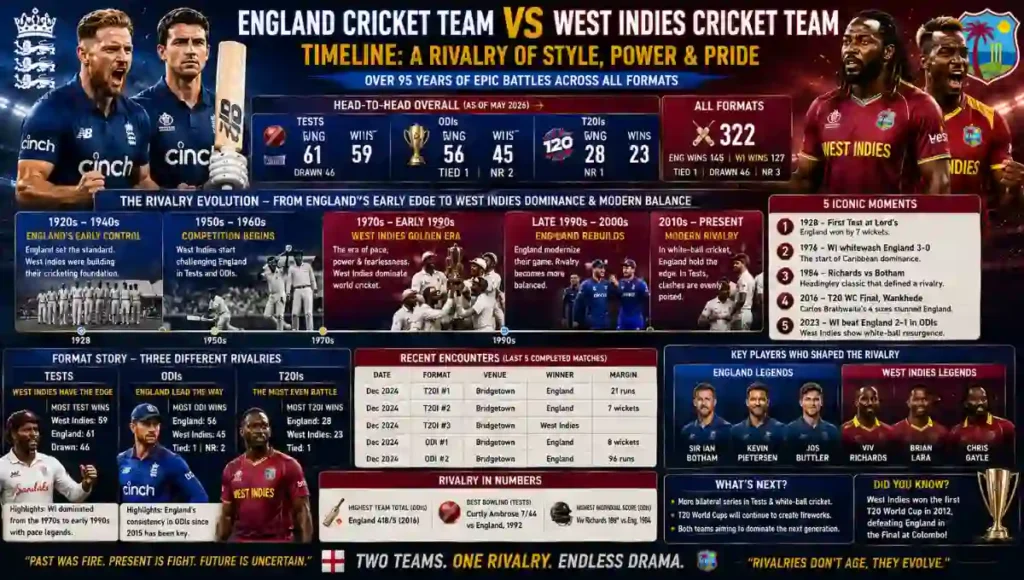

The England cricket team vs West Indies cricket team timeline is one of cricket’s most revealing rivalries because it tracks a real shift in power, not just a list of results. England started as the established force, West Indies rose into a fearsome all-format side, and the modern era has turned the matchup into a tactical contest shaped by format, conditions, and execution.
What most articles miss is this: the rivalry is not one story. It is three different stories in Tests, ODIs, and T20Is, and each one tells you something different about how cricket evolved.
Quick Rivalry Snapshot
- First Test meeting: 1928 at Lord’s, won by England.
- : 1973, won by England.
- First T20I meeting: 2007, won by West Indies.
- Test edge: West Indies have historically held the stronger record overall.
- ODI edge: England have the better overall record.
- T20I balance: The shortest format has been the most even and volatile.
This is the best way to read the rivalry at a glance: history in Tests, balance in ODIs, and chaos in T20Is of England cricket team vs West Indies cricket team timeline.
Why This Rivalry Matters
The england cricket team vs west indies cricket team timeline matters because it mirrors the rise, challenge, and reinvention of modern cricket. England once controlled the early narrative, West Indies later defined an era of dominance, and today both teams can win depending on format and conditions.
That is also why shallow articles feel incomplete. They stop at head-to-head numbers, but numbers alone do not explain momentum, confidence, or tactical change. The real story is how one rivalry moved from hierarchy to parity and then into a split-format battle.
Early Test Years
The first chapter began in 1928 at Lord’s, when England beat West Indies in the opening Test. That result established the original hierarchy, with England as the benchmark and West Indies as the challenger still learning how to compete at the highest level.
Here is the important part: the early mismatch is not a weakness in the story. It is part of the story. It shows how dramatic West Indies’ later rise really was.
What people think vs reality
- People think the rivalry became important only when West Indies became strong.
- Reality: the early imbalance is what makes the later West Indies rise more meaningful.
What readers should notice
- England had structure and status.
- West Indies had ambition and long-term potential.
- The early era was about proving they belonged, not about equal footing.
West Indies Rise
West Indies’ first win over England came in 1930 in Georgetown. That result mattered because it broke the feeling of inevitability around England. Once West Indies could win, the rivalry had a future.
The real shift came later, especially from the 1970s to the early 1990s, when West Indies became the most feared team in world cricket. Their pace attack, batting depth, fielding standards, and competitive edge changed the tone of every series.
Why West Indies became dominant
- They had fast bowlers who could control whole sessions.
- They had batters who could absorb pressure and punish mistakes.
- They developed a winning identity that repeated across generations.
This is where many articles stay too generic. They say “West Indies were dominant,” but the deeper truth is that their dominance came from psychological control as much as skill. England were not only facing quality players; they were facing an era of England cricket team vs West Indies cricket team timeline.
ODI Era Begins
The ODI format added a new layer in 1973, when England and West Indies first met in one-day cricket. England won that first ODI, and that set up a contest that would be far more balanced than the Test rivalry had been.
England later built a stronger white-ball identity, and the ODI record reflects that. MyKhel’s head-to-head summary shows England with the edge in ODIs overall, which is a major part of why this rivalry cannot be understood through Tests alone.
Why ODI cricket changed the balance
- Limited overs reduced the long-form advantage of sustained pressure.
- Field restrictions created more scoring chances.
- Tempo mattered more than control over five days.
- England’s white-ball structure became more effective over time.
What most people miss is that ODI cricket flattened old power gaps. In Tests, dominant sides could wear teams down. In ODIs, one good powerplay or one smart finishing phase could change the result. England cricket team vs West Indies cricket team timeline
T20 Era and Volatility
T20 cricket made the rivalry even more unpredictable. West Indies won the first T20I between the two sides in 2007, and that mattered because the format suited their explosive style. Since then, the rivalry has moved through tight series, momentum swings, and results that often depended on one short burst of control.
Crictracker’s 2026 T20I preview notes how close the rivalry has been in the format overall, with West Indies holding only a narrow edge. That tells you everything about T20 cricket: there is little room for reputation. One phase can decide everything.
Why T20Is feel different
- One over can flip the match.
- Toss, powerplay, and death bowling matter heavily.
- Batting intent is more important than long-form patience.
- A team can look dominant for 15 overs and still lose.
This is where things go wrong for readers who only think in historical terms. In T20s, old dominance does not always travel well. Matchups, roles, and pressure execution matter more than legacy.
Key Turning Points
The england cricket team vs west indies cricket team timeline becomes much clearer when you isolate the matches and eras that changed the rivalry’s mood.
1928: first meeting
England’s innings win created the first hierarchy.
1930: West Indies’ first win
This showed West Indies could convert potential into performance.
1973: ODI entry
England got an early win in the new format, and that gave them a more realistic path to parity.
2007: first T20I
West Indies won the first T20I, which fit their aggressive white-ball identity.
2023 to 2026: modern volatility
Recent T20 and white-ball results show the rivalry now depends more on form and conditions than on any fixed pecking order.
A useful way to read the timeline is this: every time the format changes, the rivalry resets slightly. That is why the same two teams can tell such different stories across Tests, ODIs, and T20Is.
Format Records
| Format | Broad trend | Meaning |
| Tests | West Indies historically stronger overall | This is where West Indies’ peak era is most visible. |
| ODIs | England have the better overall record | England’s white-ball structure has often been more reliable. |
| T20Is | Extremely close and highly unstable | Small margins and matchups decide the result. |
This table is important because it shows the rivalry is not one flat archive. It is three separate contests with different competitive logic with England cricket team vs West Indies cricket team timeline
What readers should take from this
- Use Tests to understand history.
- Use ODIs to understand tactical balance.
- Use T20Is to understand current volatility.
What Changed Over Time
The biggest shift in this rivalry is not just skill. It is control. In the older era, West Indies controlled fear through pace and intensity. England had to survive reputation as much as bowling.
In the modern era, control comes from planning, role clarity, and batting depth. Teams now win through powerplay management, bowling matchups, and middle-overs discipline. That is why the rivalry has become less symbolic and more tactical.
What people think vs reality
- People think aggression alone decides modern white-ball cricket.
- Reality: aggression without structure usually fails under pressure.
Two original observations
- England’s modern white-ball strength comes from knowing exactly who attacks, who anchors, and who finishes.
- West Indies’ best sides still match England’s explosiveness, but inconsistency has often been the difference.
That is a major reason the rivalry still feels alive. It is no longer about one side being permanently superior. It is about which team executes better on the day. England cricket team vs West Indies cricket team timeline
Modern Era Context
Recent series have shown how fast the balance can change. England’s 2025 tour of the West Indies produced strong white-ball results, but West Indies answered with a powerful win over England in the 2026 T20 World Cup. That contrast is the modern rivalry in one sentence: form travels, but it does not always last.
This is also why the matchup remains valuable for searchers. Fans are not only looking for history. They want current meaning. They want to know whether the old power structure still exists, and the answer is no.
What matters now
- Current squad depth.
- Recent form in the format being played.
- Pace-bowling fitness.
- Middle-order stability.
- How each side handles pressure overs.
If you are following this rivalry today, do not ask only who has the bigger name. Ask who has the better fit for the format.
Rivalry Record Holders
A high-ranking timeline article becomes stronger when it also answers the “who leads the charts?” question. The rivalry has produced many standout performances, and those numbers help readers connect history with individual impact of England cricket team vs West Indies cricket team timeline.
What to add in a live publishing version
- Highest run-scorers in England vs West Indies matches.
- Top wicket-takers in the rivalry.
- Best individual scores.
- Best bowling figures.
- Highest team totals in each format.
Why this section matters
- It improves snippet potential.
- It gives readers quick-value information.
- It makes the article feel complete, not just narrative-led.
Venue Influence
Venue context is a major missing piece in weaker competitor articles. England vs West Indies is not the same story at Lord’s, Bridgetown, Kingston, The Oval, or Basseterre. Some venues reward seam and patience; others reward power and momentum.
What venue tells you
- English venues often amplify seam movement and pressure.
- Caribbean venues can reward pace, bounce, and shot-making.
- Neutral or World Cup venues often reduce historical bias.
Read More About – Nepal National Cricket Team Vs United Arab Emirates National Cricket Team Match Scorecard: DLS Drama, Bhurtel’s Brilliance, and a Series Perfectly Poised
Why this matters
The same matchup can look completely different depending on where it is played. That is one reason the rivalry remains unpredictable across eras of England cricket team vs West Indies cricket team timeline.
What Readers Should Do Next
If you are using this timeline for research, content planning, or match analysis, the smartest next step is to read it in layers.
- Start with the era timeline to understand the story.
- Move to format records to understand balance.
- Use the turning-point section to understand why momentum shifted.
- Check current series form before making any prediction.
That is the practical value of a good england cricket team vs west indies cricket team timeline article: it should help you understand the past and read the next match better.
Frequently Asked Questions
Q1. When did England and West Indies first play each other?
Ans. They first met in Test cricket at Lord’s in 1928.
Q2. Who won the first England vs West Indies match?
Ans. England won the first Test by an innings and 58 runs.
Q3. When did England and West Indies first play ODI cricket?
Ans. Their first ODI match was in 1973.
Q4. When did England and West Indies first play T20I cricket?
Ans. Their first T20I was in 2007, and West Indies won it.
Q5. Which team has historically been stronger in Tests?
Ans. West Indies have historically had the edge in Tests.
Q6. Which team has the better ODI record?
Ans. England have the stronger ODI record overall.
Q7. Are England and West Indies evenly matched in T20Is?
Ans. Yes, T20Is have been the closest and most volatile part of the rivalry.
Q8. Why did West Indies dominate England for so long?
Ans. Because of pace-bowling intimidation, strong batting depth, and a winning culture that defined an era.
Q9. Why is the rivalry still important today?
Ans. Because the contest changes by format, and both teams can still beat each other in major matches.
Q10. What is the best way to study this rivalry?
Ans. Read it by era, then by format, then by key turning points. That gives the clearest picture of how the rivalry evolved.