
Cricket does not close at a fixed time. Test matches end each day around 6:00–6:30 PM local time, ODIs close between 5:30 PM and 10:30 PM depending on start type, and T20/IPL evening matches typically close between 10:30 PM and 11:00 PM IST. Exact closing times depend on format, over completion, weather, and ICC playing conditions.
You are watching a match. An over is bowled. The fielding side takes forever to set up. The umpires confer. The crowd shifts. And suddenly, play stops for the day just like that.
But nobody told you when it would end. That is the real frustration.
Cricket does not follow a clock. There is no buzzer, no fourth-quarter timer, no hard stop at 90 minutes. When people search for what time does cricket close, they often land on pages that give vague estimates and nothing else. This guide is different. It breaks down every format, every country, every rule that governs when a cricket match actually closes and what that means for you as a viewer.
Cricket Has No Universal Closing Time
The single most important thing to understand about what time cricket closes: it is a calculated outcome, not a scheduled event.
Three things can end a day’s play. A result is reached. The scheduled overs and last-hour time are completed. Or conditions bad light or rain force players off the field.
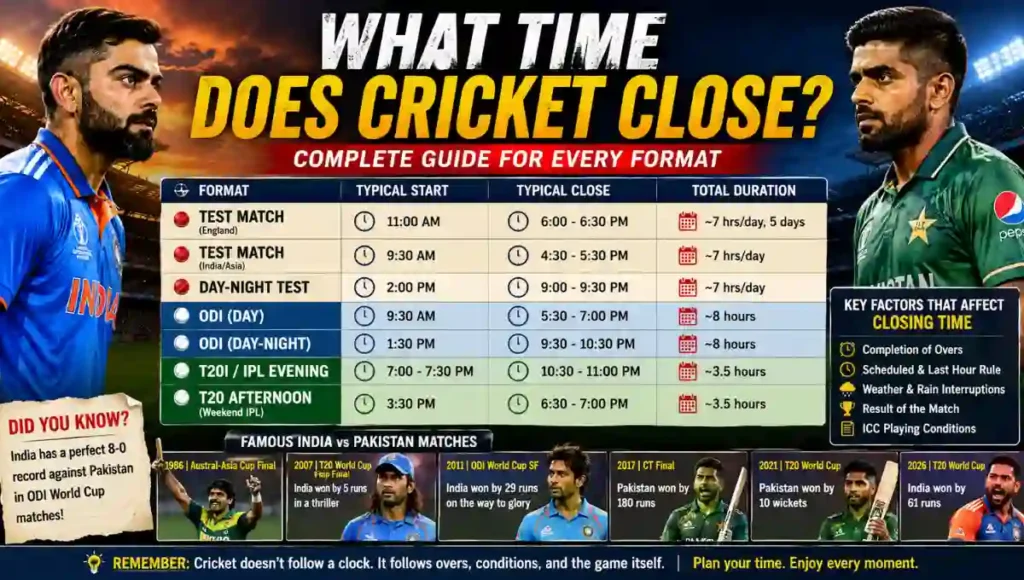
Closing Times by Format at a Glance
| Format | Typical Start | Typical Close | Total Duration |
| Test Match (England) | 11:00 AM | 6:00–6:30 PM | ~7 hrs/day, 5 days |
| Test Match (India/Asia) | 9:30 AM | 4:30–5:30 PM local | ~7 hrs/day |
| Day-Night Test | 2:00 PM | 9:00–9:30 PM | ~7 hrs/day |
| ODI (Day) | 9:30 AM | 5:30–7:00 PM | ~8 hours |
| ODI (Day-Night) | 1:30 PM | 9:30–10:30 PM | ~8 hours |
| T20I / IPL Evening | 7:00–7:30 PM | 10:30–11:00 PM | ~3.5 hours |
| T20 Afternoon (Weekend IPL) | 3:30 PM | 6:30–7:00 PM | ~3.5 hours |
This table is your starting point. But real-world closing times often shift. Understanding why separates informed cricket fans from frustrated ones.
Test Match Closing Times: The Full Breakdown
If you are asking what time does cricket close in a Test match, the short answer is: around 6:00 PM local time per day, with possible extensions up to 6:30 PM and sometimes later.
A Test match runs across five days. Each day is divided into three sessions with scheduled breaks.
Test Match Daily Session Structure
| Session | UK / England Time | Duration |
| Morning Session | 11:00 AM – 1:00 PM | ~2 hours |
| Lunch Break | 1:00 PM – 1:40 PM | 40 minutes |
| Afternoon Session | 1:40 PM – 3:40 PM | ~2 hours |
| Tea Break | 3:40 PM – 4:00 PM | 20 minutes |
| Evening Session | 4:00 PM – 6:00 PM | ~2 hours |
In England, Test play begins at 11:00 AM and closes around 6:00 PM or up to 6:30 PM if overs were lost to weather. For viewers in India watching England Tests, close of play lands around 10:30–11:00 PM IST.
The target each day is 90 overs. If the fielding side completes 90 overs before 6:00 PM, play ends early. If overs are lost to rain, play extends. The clock and the over count must both be satisfied before the day is officially closed.
The Last Hour Rule Why Play Often Runs Past 6:00 PM
This is the rule that confuses most viewers, and understanding it answers a lot of questions about what time cricket closes.
One hour before scheduled close, the “last hour” officially begins. The ICC playing conditions require a minimum of 15 overs to be bowled in that final hour. Play does not end at the clock’s 60-minute mark. It ends when both conditions are met 60 minutes have elapsed AND 15 overs have been bowled whichever comes later.
This means: if the fielding side is slow, play extends until all 15 overs are done, even if the clock already reads 6:00 PM. On a tense Day 5, this can push close of play to 6:30 PM or beyond. The umpires are not being lenient they are following the law.
The ICC Stop Clock Rule (June 2025)
In June 2025, the ICC introduced a stop-clock rule for Test matches a change that directly impacts when cricket closes each day.
The fielding side must now be ready to bowl within 60 seconds of the previous over ending. Two warnings are issued for non-compliance. A five-run penalty applies on the third offence. Warnings reset after every 80 overs.
This rule was already in place for ODIs and T20Is. Extending it to Tests signals the ICC’s intent to enforce tighter daily over rates and prevent matches from dragging past their scheduled close.
The Day 5 Exception Most Fans Do Not Know
The final day of a Test match operates under a rule that applies to no other day. Captains can mutually agree to end play early on Day 5 if no result is possible even before the last hour begins. No other day in Test cricket carries this provision. This means that on the last day, cricket closes when the game itself decides it is over.
ODI Match Closing Times Explained
The closing time for an ODI depends almost entirely on whether it is a day match or a day-night match. That distinction alone can shift the end time by four to five hours.
An ODI is 50 overs per side. Including innings breaks, drinks breaks, and lunch/tea intervals, a full ODI runs for approximately 8–9 hours from first ball to last.
ODI Timing Categories
| Start Type | Typical Start | Typical Close |
| Day match | 9:30 AM local | 5:30 PM – 7:30 PM |
| Day-Night match | 1:00–2:00 PM local | 9:00 PM – 10:30 PM |
| Night match (rare) | 7:00 PM | Past midnight (possible) |
What people assume: An ODI ends around tea time.
Reality: Day-night ODIs now dominate the bilateral series calendar, especially on the subcontinent. For Indian home ODIs starting at 1:30 PM IST, close of play typically lands between 9:30 PM and 10:30 PM IST. Viewers planning their evening need to account for this.
How DLS Changes ODI Closing Time
When rain interrupts an ODI, the Duckworth-Lewis-Stern (DLS) method recalculates the target based on remaining overs and wickets in hand. A DLS-reduced match can close significantly earlier sometimes by two to three hours because one or both innings are shortened. This is why, for what time does cricket close in rain-affected ODIs, there is genuinely no single answer. The DLS outcome, not the clock, determines when the game ends.
T20 and IPL Match Closing Times
If you want to know what time does cricket close for a T20 or IPL match, the rule of thumb is simple: add 3 to 3.5 hours to the start time. A 7:30 PM start puts close of play at approximately 10:30–11:00 PM IST.
T20 is cricket’s evening format. 20 overs per side, no mandatory lunch break, two strategic timeouts per innings of 2.5 minutes each.
IPL 2026 Match Timing Schedule
IPL 2026 runs from 28 March to 31 May 2026, featuring 74 matches across 13 venues. All evening games start at 7:30 PM IST. Weekend afternoon games begin at 3:30 PM IST.
| IPL Match Type | Start Time (IST) | Expected Close Time (IST) |
| Weekday evening match | 7:30 PM | 10:30 PM – 11:00 PM |
| Weekend afternoon match | 3:30 PM | 6:30 PM – 7:00 PM |
| Double-header 1st game | 3:30 PM | ~6:30 PM |
| Double-header 2nd game | 7:30 PM | ~11:00 PM |
The IPL 2026 Final is scheduled for 31 May at Bengaluru. A 7:30 PM start means close of play is expected around 11:00 PM IST, assuming no rain interruptions.
What Extends or Delays T20 Closing Time
- Strategic timeouts: Two per innings, each 2.5 minutes
- Stop clock violations: Effective since ICC’s 2024 ODI/T20I rollout
- Rain and DLS recalculation: Can shorten or delay the match significantly
- Slow over rate: Fielding teams face penalties but can still delay proceedings
- Floodlight or power failures: Rare, but documented in domestic leagues
The counterintuitive truth: T20 matches can also close faster than expected. If a team collapses chasing a low target in 10–12 overs, a T20 can wrap in under 2.5 hours closing well before 10:00 PM. The format cuts both ways.
How Country and Venue Affect What Time Cricket Closes
Geography is one of the most underappreciated factors in understanding when cricket ends. The same format can close two hours apart depending on where in the world the match is being played.
England and Australia
In England, Tests start at 11:00 AM to exploit the long summer daylight hours. In Australia, games start earlier around 9:30 AM because dusk arrives earlier in most seasons. At venues like Edgbaston, the spectator guide officially lists close of play at 6:00 PM (or 90 overs completed), with the over count taking precedence over the clock.
India and the Subcontinent
Test matches in India typically start at 9:30 AM IST, ensuring all three sessions complete before dusk. Day-night Tests introduced to India through pink-ball cricket at Eden Gardens push start times to 1:00–2:00 PM, extending close of play to 8:00–9:00 PM local time.
Day-Night Tests: The Pink Ball Factor
Day-night Tests are structured specifically so that the most dangerous passage of play falls under artificial lights. The twilight period roughly 6:30–7:30 PM local time is when conditions transition from natural to floodlight. The pink ball’s behaviour changes visibly during this window, creating extra movement and challenging the batsmen’s ability to read pace and swing.
A typical day-night Test day:
- Start: 2:00 PM local
- Tea break: 4:00–4:20 PM
- Dinner break: 6:20–7:00 PM
- Close of play: 9:00–9:30 PM
The dinner break replaces the traditional tea break in day-night Tests a structural change many viewers overlook when trying to track what time cricket closes in this format.
Weather’s Role in Changing Match Closing Times
Cricket is the only major international sport that stops entirely when it rains. Unlike football or basketball, play cannot continue through precipitation.
When play is suspended, overs are lost. In Test cricket, umpires can extend the day’s play by up to one hour to recover lost overs. This is why a Test that was scheduled to close at 6:00 PM can push to 7:00 PM without any rule violation.
What most fans miss: Even after close of play is triggered, if an innings ends within the last 10 minutes of the scheduled day, a new innings does not begin. Play ends there. This rule prevents meaningless late-evening starts and protects both teams’ preparation time.
Read More About – England Cricket Team vs India National Cricket Team Players: The Complete 2025 Breakdown
Broadcast, Fantasy, and Betting: Why Close-of-Play Time Is a Financial Marker
The exact time cricket closes is not just a scheduling question it is a financial one.
Broadcast networks structure ad inventory around session breaks and close-of-play. Fantasy scoring platforms like Dream11 lock their lineup deadlines based on toss time and first ball. In-play betting operators price every over based on projected remaining play time. A 30-minute rain delay at 5:45 PM can shift millions in live betting markets and invalidate hours of pre-planned fantasy strategy.
Most cricket fans never think about this layer. But it explains why broadcasters obsessively track over rates, why fantasy platforms build weather-delay policies, and why ICC’s stop clock rule was a business decision as much as a playing-conditions one.
Practical Steps: Never Get the Closing Time Wrong Again
- Check the format first. Test? Block out the whole evening. T20? You need 4 hours maximum.
- Always note the local start time not just IST or GMT conversions. Most viewer confusion comes from timezone miscalculation.
- Follow official broadcaster pre-match coverage. They announce expected close time adjusted for local conditions.
- For Test matches, add a 30–60 minute buffer. Weather extensions and over-rate delays are standard, not exceptional.
- Use ESPNcricinfo or Cricbuzz for live tracking. Both apps display scheduled and projected close of play in real time.
- For day-night ODIs in India, plan for a 10:00–10:30 PM close minimum not 7:30 PM.
Frequently Asked Questions
Q1: What time does a cricket match end today?
Ans. It depends on format and start time. T20s end in 3–4 hours, ODIs in 7–9 hours, and Test matches close around 6:00 PM local time per day. Always check the format first.
Q2: What time does an IPL match end?
Ans. Most IPL 2026 evening matches start at 7:30 PM IST and close between 10:30 PM and 11:00 PM IST. Weekend afternoon games start at 3:30 PM and close around 6:30–7:00 PM IST.
Q3: Does Test cricket always close at exactly 6:00 PM?
Ans. No. In England, 6:00 PM is the scheduled close, but play can extend to 6:30 PM or beyond to compensate for overs lost to weather or slow over rates. The 15-over last-hour rule is the key factor.
Q4: Can a cricket match be called off mid-session?
Ans. Yes. Rain, bad light, or exceptional circumstances can end play at any point. Umpires hold sole authority to remove players from the field.
Q5: What is the last hour rule in Test cricket?
Ans. One hour before scheduled close, the last hour begins. A minimum of 15 overs must be bowled. Play ends when both 60 minutes have elapsed AND 15 overs are complete whichever comes later.
Q6: What time do day-night Test matches close?
Ans. Day-night Tests typically start at 2:00 PM local time and close around 9:00–9:30 PM, depending on weather and over completion. The dinner break replaces the traditional tea break.
Q7: What time does an ODI end in India?
Ans. Day-night Tests typically start at 2:00 PM local time and close around 9:00–9:30 PM, depending on weather and over completion. The dinner break replaces the traditional tea break.
Q8: What is close of play in cricket?
Ans. “Close of play” (COP) is the formally agreed time at which each day’s Test match play ends. It is set before the match begins by the host board and on-field umpires, subject to ICC playing conditions.
Q9: Can umpires extend play beyond the scheduled close?
Ans. Yes. Umpires can extend play by up to one hour per day to recover overs lost to weather or interruptions. Additional time can also be carried over to subsequent days under ICC rules.
Q10: How does weather affect what time cricket closes?
Ans. Rain halts play entirely. Lost overs are tracked, and umpires can extend the day to compensate. In limited-overs formats, the DLS method recalculates targets and can shorten the match, causing it to close earlier than expected
.